In 2024, during a temporary return to Japan, I came into possession of two heirlooms.
The first was a booklet titled Nature of Gotemba, published in 1972. Its cover features a photograph of Mount Fuji and magnolia blossoms taken by my grandfather, who once ran a photo studio in my hometown of Gotemba, Japan. The second was a lens that my grandfather had used in the 1950s, which my grandmother had carefully preserved. By the time I was a child, my uncle had already taken over the studio, and I had never seen any of the photographs my grandfather had taken.
After the Second World War, a former Japanese military base in Gotemba was requisitioned by the U.S. military for several years. Part of the site is still in use today as Camp Fuji. Against this historical backdrop, my grandfather’s studio welcomed not only local residents but also many American servicemen who came to have commemorative portraits taken. More than seventy years later, the lens that once looked out at people who had come from a foreign land has now been passed into the hands of someone living abroad—me. And it now looks once again toward my hometown. In this shift, the direction of the gaze seems to be reversed. The lens my grandfather used and the booklet containing a photograph he took: coming into possession of these two heirlooms prompted me to begin thinking about how to give material form to memories that fade with time.
Rather than deciding in advance on the final composition, format, or techniques of the work, I chose to incorporate ideas as they emerged throughout the process. First, I mounted my grandfather’s lens on a large-format camera manufactured in Berlin around 1900 and photographed Mount Fuji and the magnolia blossoms shown on the cover of Nature of Gotemba. Instead of film, I loaded a sheet of photographic paper into the film holder and made what would become the first paper negative.
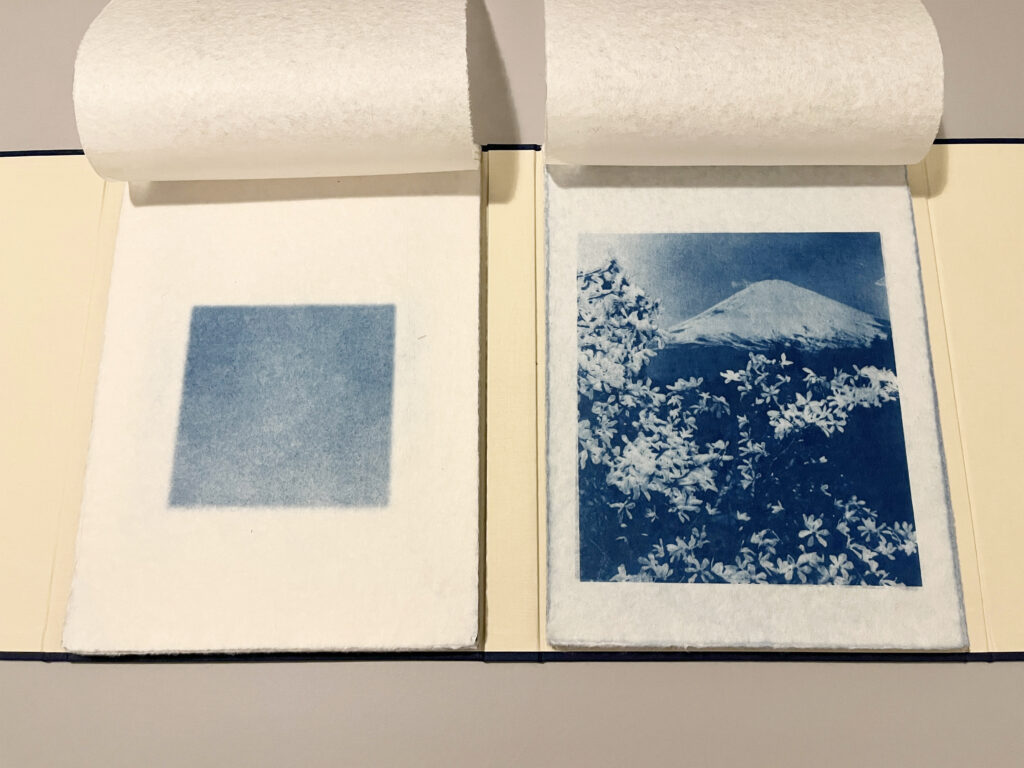
Starting from this paper negative, I repeated the inversion between negative and positive more than one hundred times over a period of approximately two months, using contact prints made on photographic paper. Throughout this process, the original image gradually changed, eventually losing its contours. I began to see this transformation of the image as an analogy for the fading of memory. Of the resulting prints, I scanned fifty-three negatives and used them to create film negatives for cyanotype printing. Each page corresponds to one year of the fifty-three years from 1972, when the booklet was published, to 2024, when I encountered it.
There were two reasons for my eventual decision to use the cyanotype process. The first was the meaning of the word blueprint/青写真 (Ao-Jashin in Japanese), which was named after the white-on-blue results of the cyanotype process. As it was often used in the reproduction of architectural plans, the term has also come to signify a plan or vision for the future. This broader meaning resonated with a work that traces memories of the past while directing its thoughts toward the future. The second was the historical connection between Prussian blue, the color produced by cyanotype, and Berlin, where I now live. The pigment is believed to have been accidentally discovered in Berlin in the early eighteenth century. I felt there was something particularly meaningful about using a color associated with Berlin in a work that begins with the landscape of my hometown, Gotemba.
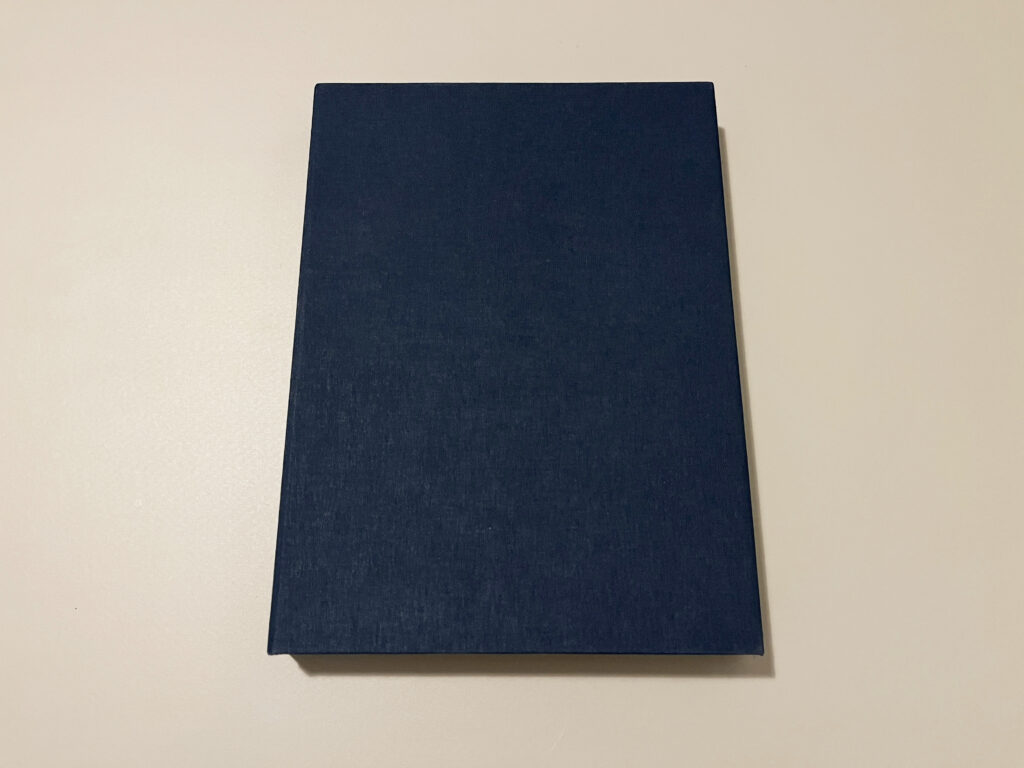
I bound the cyanotype prints using traditional Japanese stab binding, creating a book-like object whose pages turn upward, much like those of a calendar. With each turn of the page, the original image gradually fades. As I continued working, however, a question suddenly occurred to me: Does memory truly fade with time? And even if it does, can memory really be represented as a process that moves in only one direction?
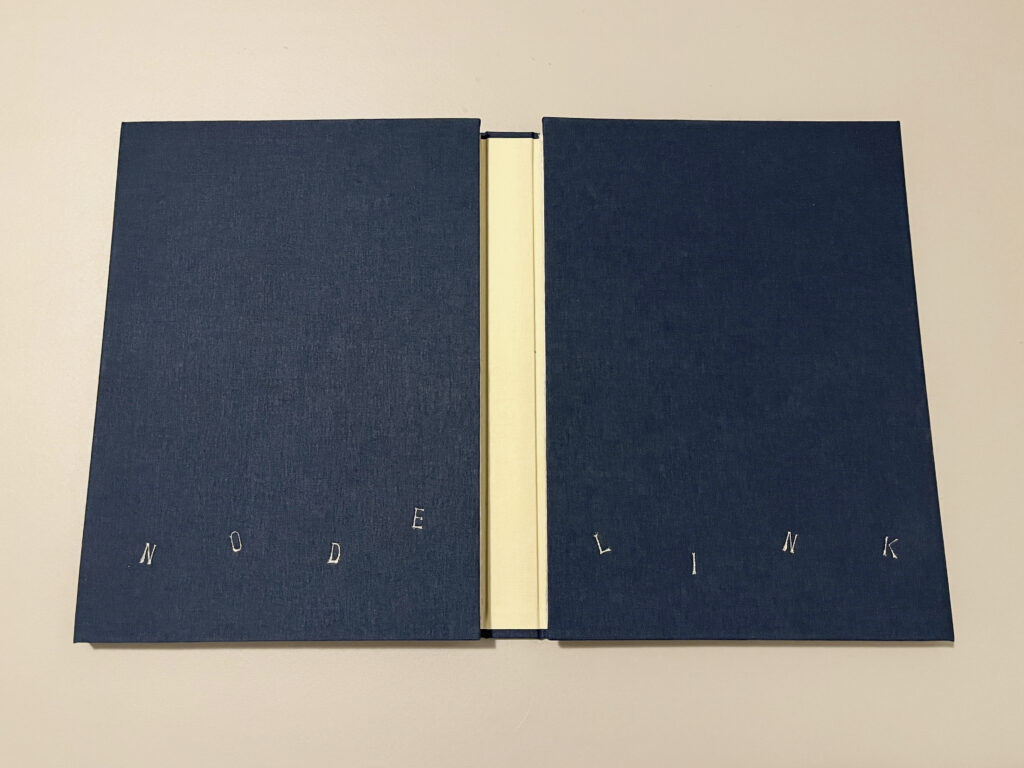
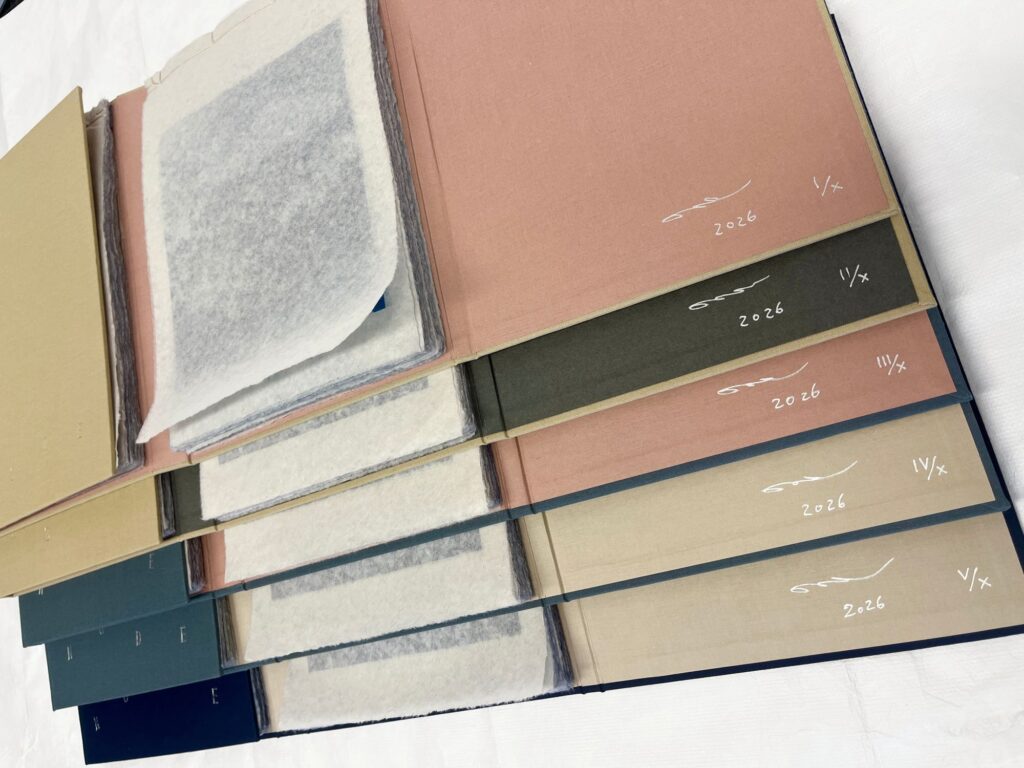
Throughout this extended period of making, I called my mother and my two aunts in Japan countless times. My eldest aunt, in particular, knows a great deal about the early days of the photo studio. She, too, enjoyed retracing memories that had nearly been forgotten, and sharing this process with me. Over the course of the lengthy production process, the smell of photographic processing chemicals lingering in the darkroom and the glow of the red safelight became triggers for memories of the studio, which had also been my playground as a child. In other words, although I had set out to represent memories fading away, I realized that the process of making the work was also bringing nearly vanished memories back to life. At the same time, I was weaving together fragments of memories held separately by my mother, my aunts, and myself. In response to this realization, I created a second sequence of prints that moves in the opposite direction from the original set of fifty-three, placing the two sequences side by side. When the book is opened from both sides, the two sequences become visible.
When opened from the right, like a traditional Japanese book, it begins with a print from 1972. Conversely, when opened from the left, like a Western book, it begins with a print whose image has almost faded away, evoking a memory from 2024. This structure also reflects my two homes: Gotemba and Berlin.
The nature of memory is probably far more three-dimensional and complex than these two simple opposing directions suggest. When the two sequences of prints are closed together, they form a single three-dimensional work in the shape of a book. Through the repeated physical process of contact printing, the original image did indeed disappear. But what then can be seen in these prints?
To me, they look unmistakably like a blue sky.
Perhaps this is because the blue evokes the name of my grandfather’s photography studio, a name that will never disappear from my memory: AOZORA-Studio. (Aozora means “blue sky” in Japanese)
Did the original image disappear, leaving a blue sky behind? Or did the blue sky emerge?